
Short answer
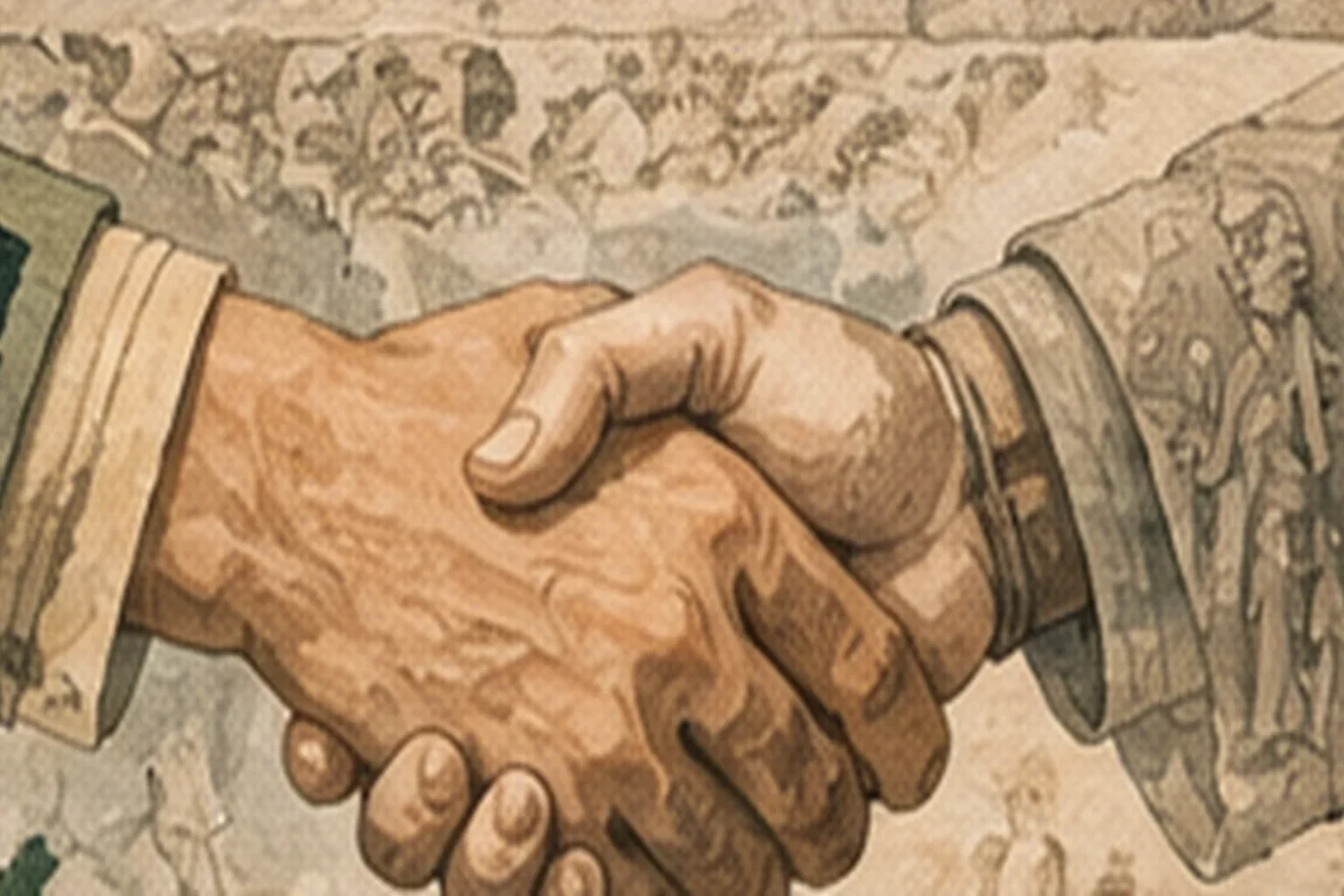
Why do we shake hands? The gesture has sealed agreements for nearly 3,000 years: an Assyrian relief from the ninth century BC shows two kings clasping hands to confirm an alliance. Its use as an everyday greeting is more recent. Historians often credit the Quakers, who in the 17th and 18th centuries preferred the handshake to bowing because it treated everyone as equals.
Key takeaways
- One of the earliest depictions of a handshake is an Assyrian relief from the ninth century BC showing two kings sealing an alliance.
- In ancient Greece and Rome, clasped hands stood for trust, loyalty and friendship, and appear on gravestones and coins.
- The popular idea that it began as a way to show you carried no weapon is a theory, not a documented origin.
- As an everyday greeting between equals, the handshake owes much to the Quakers, who preferred it to bowing or removing a hat.
- By the 19th century, etiquette manuals had rules for it, and by the 20th century doctors were already warning about germs.
It is the most ordinary of gestures, so ordinary that we only think about it when it disappears, as it did for a while during the Covid-19 pandemic. Its history shows two different handshakes: one that seals a promise, and one that simply says hello.
A gesture carved in stone
One of the earliest known depictions of a handshake is a stone relief from the ninth century BC. It shows King Shalmaneser III of Assyria clasping hands with a Babylonian ruler to seal an alliance. The gesture there is not casual: it is a public, political act, carved so that others would see it.
Trust in Greece and Rome
In ancient Greece, the handshake appears in Homer’s Iliad and Odyssey, usually connected with pledges and trust. In the fifth and fourth centuries BC, it became a common image on gravestones, where a dead person is shown clasping hands with a member of the family, a farewell and a promise of connection.
In Rome, a pair of clasped hands appeared on coins as a symbol of loyalty and friendship. In both cultures, the joined right hands meant something serious: an agreement, a bond, a promise kept.
The weapon theory
The most popular explanation for the handshake is that it began as a way to show peaceful intent: an open right hand proved that it held no weapon. A related version says the up-and-down shake was meant to dislodge a knife hidden in a sleeve.
It is a satisfying story, and it may contain some truth, but it is a theory. No ancient source explains the handshake this way, and the earliest depictions show it as a sign of agreement between people who already meant to trust each other.
The Quakers and the equal greeting
For centuries in Europe, greetings reflected rank. People bowed, curtsied or removed their hats to those above them. The Quakers, a Christian movement that emerged in 17th-century England, rejected these signs of deference as incompatible with the equality of all people before God.
In their place, as the historian Michael Zuckerman writes, the Friends put “the practice of the handshake, extended to everyone regardless of station.” Historians often credit the Quakers with helping turn the handshake into an everyday greeting, especially in America, where their influence was strong in the 18th century.
Rules, manners and germs
By the 19th century, the handshake had become ordinary enough to need rules. Etiquette manuals explained when to offer a hand, who should offer first and how firmly to grip. One guide from 1877 warned that a gentleman who “too violently shakes it” should not be given a second chance to offend.
The worries were not only social. In 1929, a nurse named Leila Given wrote in the American Journal of Nursing that hands “are agents of bacterial transfer”, and suggested adopting the Chinese custom of pressing one’s own hands together instead. “At least our bacteria would then stay at home,” she added. Few people took her advice until the pandemic of 2020, when many people stopped shaking hands for a while.
Two handshakes, one gesture
| The agreement | The greeting | |
|---|---|---|
| Oldest evidence | Assyrian relief, 9th century BC | Quaker practice, 17th and 18th centuries |
| Meaning | A pledge, an alliance, a deal | Equality and courtesy |
| Where it survives | Contracts, treaties, sports | Meeting someone new |
What the story tells us
The handshake survived because it carries both meanings at once. When two people shake hands at the end of a negotiation, they repeat the gesture of Assyrian kings; when they shake hands on meeting, they repeat the Quakers’ quiet statement that no one in the room needs to bow. Few gestures have done so much work for so long with so little effort.
The blessing after a sneeze is another everyday habit with ancient roots and a misleading origin story. See Why Do We Say “Bless You”?, or explore Customs & Traditions.
Frequently asked questions
Where did the handshake originate?
One of the earliest depictions is a ninth-century BC Assyrian relief of King Shalmaneser III clasping hands with a Babylonian ruler to seal an alliance. The gesture also appears in ancient Greek literature and art.
Did shaking hands start to show you had no weapon?
That is a popular theory, but it is not documented in ancient sources. The earliest depictions show the handshake as a sign of agreement and trust.
Who made the handshake a common greeting?
Historians often credit the Quakers, who preferred the handshake to bowing or removing a hat because it treated everyone as equals.
What does a handshake symbolize?
Historically, trust, agreement and loyalty; as a greeting, courtesy between equals.