
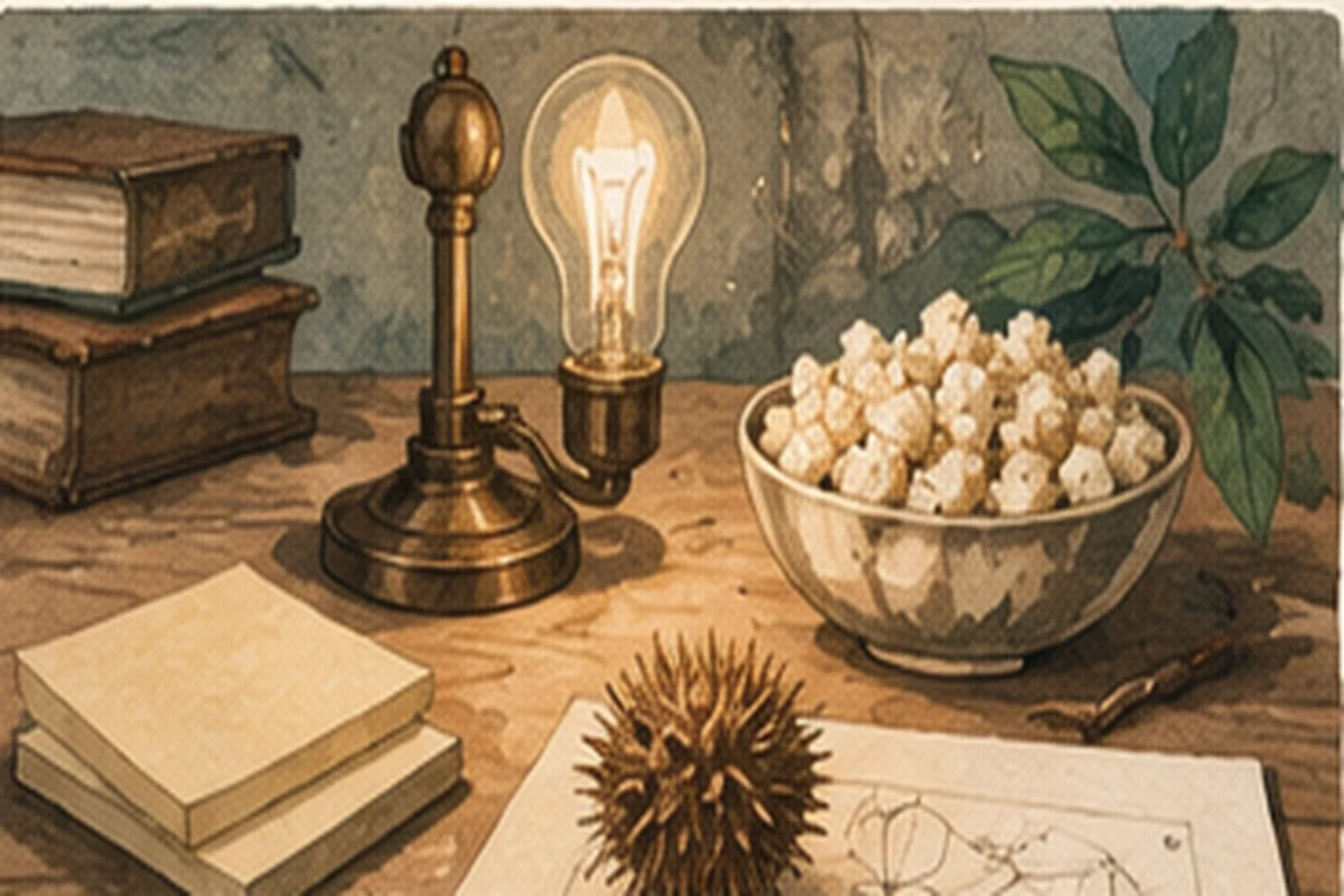
Key takeaways
- Many famous inventions began with an accident, but none was finished by one: turning a lucky moment into a product took years of work.
- The microwave oven began with a melted candy bar in 1945, Post-it Notes with a glue that was too weak, and Velcro with burrs on a dog’s coat.
- Some “accidental inventions” are legends: the story of the angry chef who invented the potato chip is not supported by evidence.
- Accidents only matter when someone notices them, asks why, and keeps going.
- Each article here separates the documented story from the one usually told.
Many of the inventions and discoveries we now take for granted began with an accident or a hunch: a melted candy bar near radar equipment, a glue that did not stick properly, burrs caught in a dog’s fur. But an accident is only the beginning. Every one of these inventions needed someone to notice what had happened, ask why, and spend years turning it into something that worked.
“Accidental inventions” make wonderful stories, and some of them are even true. This section looks at a few of the best known, and checks how much of each story is record and how much is legend.
The myth of the lucky accident
The appeal of an accidental invention is that it seems to happen by itself. A scientist makes a mistake, notices something odd, and the world changes. It is a comforting idea: genius as luck.
The real stories are different. Percy Spencer did not stop at the melted candy bar; he tested popcorn and eggs, and his company filed a patent within months. Spencer Silver’s weak glue waited years for a use, and its launch needed two rounds of market tests. George de Mestral spent nearly a decade turning the idea of the burr into a durable fastener. The accident was the spark; the invention was the work.
The articles in this section
Who Invented the Microwave? Percy Spencer, a Raytheon engineer, noticed in 1945 that radar equipment had melted a candy bar in his pocket. The first microwave oven, two years later, was nearly six feet tall.
Who Invented Post-it Notes? A reusable adhesive created at 3M in 1968 had no purpose until a colleague needed bookmarks that would not fall out of his choir hymnal.
Who Invented Velcro? George de Mestral studied the burrs stuck to his dog’s coat in 1941 and patented the hook-and-loop fastener in 1955. NASA did not invent it, but it made it famous.
Who Invented the Potato Chip? The famous story of an angry chef in Saratoga Springs in 1853 is not supported by evidence, and a recipe for fried potato shavings existed in 1817.
Accident, observation or legend?
| Invention | The spark | What it took to become real |
|---|---|---|
| Microwave oven | A melted candy bar, 1945 | Tests, a patent and 20 years to fit in a kitchen |
| Post-it Notes | A weak glue, 1968 | A use found years later and repeated market tests |
| Velcro | Burrs on a dog, 1941 | Nearly a decade of trials and the switch to nylon |
| Potato chip | An angry chef, 1853 | A legend: the recipe existed earlier |
What separates an invention from an accident
Looking across these stories, a pattern appears. Each invention needed four things:
- An unexpected result. Something did not behave as expected: a candy bar melted, a glue stayed tacky, a burr held fast.
- Someone who noticed. Many people had pulled burrs off their clothes before; one man looked at them under a microscope.
- A problem it could solve. The weak glue was useless until it met the bookmark that kept falling out.
- Years of work. Prototypes, failures, patents and tests turned a curiosity into a product.
The legends usually keep the first step and drop the rest.
Why it matters
The stories we tell about inventions shape how we think about creativity. If invention is a lucky accident, there is little to learn from it. If it is noticing, questioning and persisting, it is something anyone can practice. The real histories are less magical, but they are more useful, and they give credit to the work rather than only to the moment.
This section is one of four. The same approach is applied to dishes in Famous Foods, to rituals in Customs & Traditions, and to ordinary things in Everyday Objects.
Frequently asked questions
What are some famous accidental inventions?
The microwave oven, which began with a melted candy bar in 1945; Post-it Notes, which began with a weak adhesive in 1968; and Velcro, inspired by burrs stuck to a dog’s coat in 1941.
Was the potato chip invented by accident?
The popular story says a chef invented it in 1853 to annoy a customer, but there is no evidence for it, and a recipe for fried potato shavings was published in 1817.
Are accidental inventions really accidents?
The first observation often is, but turning it into a working product usually takes years of deliberate work.
Did NASA invent Velcro?
No. Velcro was patented in 1955 by George de Mestral. NASA adopted it in the 1960s.