
Short answer
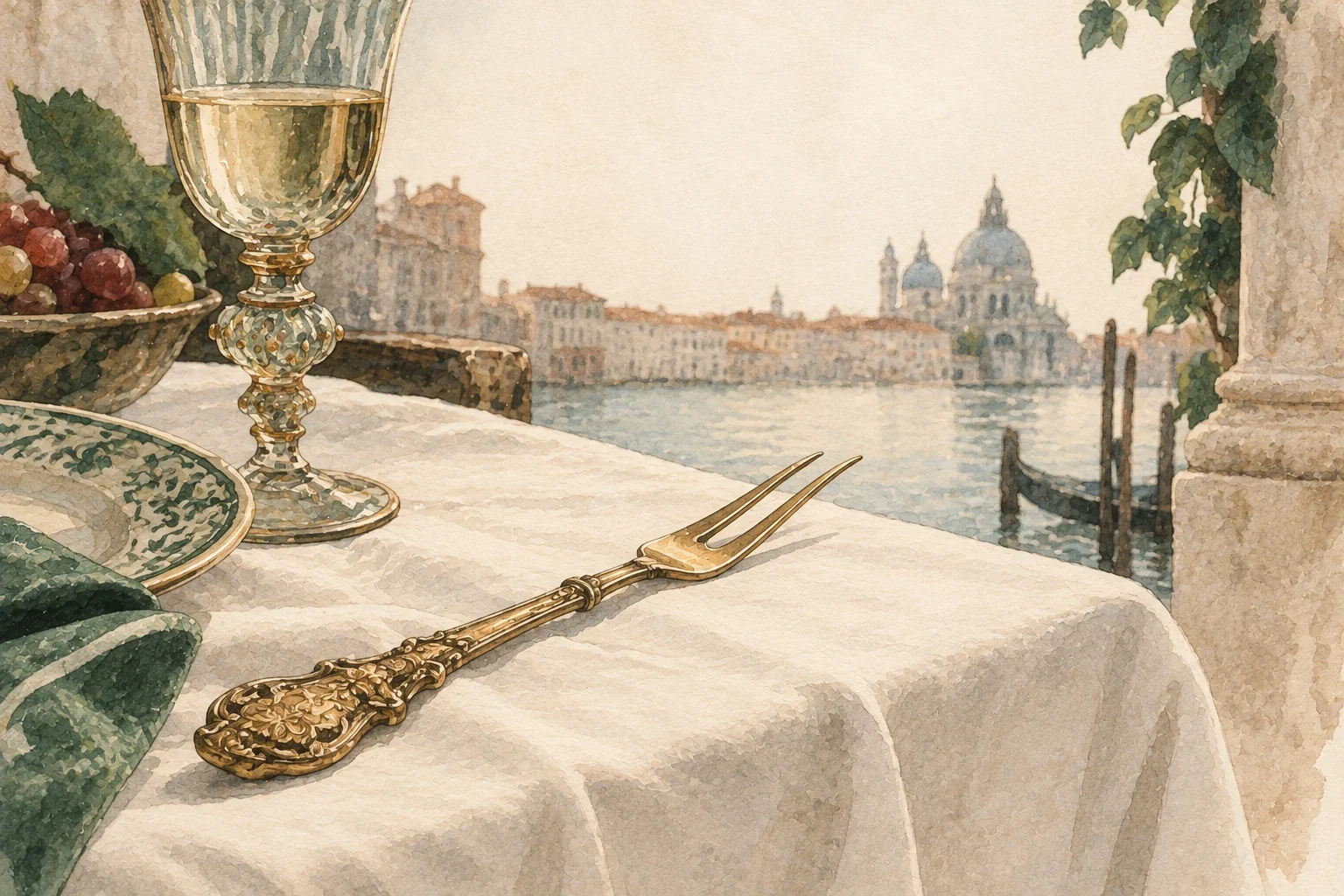
Who invented the fork? No single person. Forks for cooking and serving are ancient, but the fork as an everyday eating tool came to Europe from the Byzantine Empire. In 1004, a Byzantine bride in Venice caused a scandal by eating with a golden fork, and it took centuries for the rest of Europe to stop finding the habit ridiculous.
Key takeaways
- Forks for cooking and serving existed in ancient Egypt, Bronze Age China and Rome; forks for eating came later.
- Table forks were used by Byzantine elites by the tenth century.
- In 1004, a Byzantine noblewoman who married into the family of the Doge of Venice scandalized the city by eating with a golden fork.
- Forks became common in Italy by the 14th century, and spread to France and England only slowly, in the 16th and 17th centuries.
- In England, eating with a fork was long mocked as foreign and pretentious; it became universal only in the 19th century.
It is hard to imagine a dinner table without forks. Yet for most of European history, people ate with a knife, a spoon and their fingers, and the first person to use a fork in public in western Europe was condemned for it by a future saint.
Forks before eating
Fork-like tools are old. Early versions have been found in Bronze Age China and ancient Egypt, probably used for cooking and serving. The Romans had forks of bronze and silver, mainly for preparing food. A two-pronged silver fork found in Wiltshire, in England, has been dated to around 850, during the Saxon period.
These were kitchen and serving tools. The idea of lifting food to your mouth with a fork was something else.
Byzantium’s table manners
By the tenth century, Byzantine elites used forks freely at the table, to the surprise of guests from western Europe. By around the 11th century, table forks were appearing regularly at meals across the Byzantine Empire.
The scandal of 1004
In 1004, Maria Argyropoulina, a Byzantine noblewoman and sister of the future Emperor Romanos III, married the son of the Doge of Venice. According to the accounts, she refused to eat with her fingers and used a small golden fork.
The reaction was hostile. The churchman Peter Damian, later made a saint, criticized her use of “artificial metal forks” as vanity, and when she died young, he presented her death as a punishment from God. The fork, for a while, carried a whiff of sin.
Italy adopts it first
Italy got used to the fork before the rest of Europe. By the 14th century, forks had become common in Italy, and one reason often given is pasta: long, slippery noodles are much easier to eat with a fork than with fingers.
From Italy, the fork traveled with marriages. In 1518, the Italian noblewoman Bona Sforza married Sigismund I, king of Poland, and brought the table fork to the region. In 1533, Catherine de’ Medici married the future King Henry II of France, and she is often credited with bringing the fork to the French court, though her example did not convince many of her new countrymen at once.
England resists
In England, the fork was a joke for a long time. In 1611, the traveler Thomas Coryat published his Crudities, describing how Italians ate with forks and recommending the habit for its cleanliness. He was mocked for it and earned the nickname Furcifer, a Latin pun meaning both “fork-bearer” and “rascal”.
Even so, forks slowly entered wealthy English homes. The earliest known hallmarked English silver fork dates from 1632 to 1633. But well into the 18th century, many English people considered eating with a knife and fingers more manly and honest than using a fork. Only in the 19th century, when mass production and cheaper metals made cutlery affordable, did the fork become universal.
How long it took
| Place | When the fork reached the table |
|---|---|
| Byzantine Empire | By the 10th century, among the elite |
| Venice | 1004, as a scandal |
| Italy | Common by the 14th century |
| Poland and France | 16th century, through royal marriages |
| England | 17th century among the rich; universal in the 19th |
What the story tells us
The fork is a good reminder that table manners are not natural. Each generation thinks its way of eating is simply the correct one, and each generation’s habits once looked strange, foreign or even sinful. A tool we now consider essential was, for centuries, a sign that someone was showing off.
The toothbrush is another everyday object that took a long time and a strange story to reach its modern form. See Who Invented the Toothbrush?, or browse Everyday Objects.
Frequently asked questions
When was the fork invented?
Forks for cooking and serving date back to ancient Egypt, Bronze Age China and Rome. Forks for eating were used by Byzantine elites by the tenth century and reached western Europe from the 11th century onward.
Who brought the fork to Europe?
Its arrival is usually linked to Maria Argyropoulina, a Byzantine noblewoman who married into the family of the Doge of Venice in 1004 and ate with a golden fork.
Why were forks considered sinful?
Churchmen such as Peter Damian saw eating with an artificial metal fork as vanity, and Damian presented the early death of the first woman known to use one in Venice as divine punishment.
When did the English start using forks?
Wealthy English homes adopted forks during the 17th century, but they became universal in England only in the 19th century.