
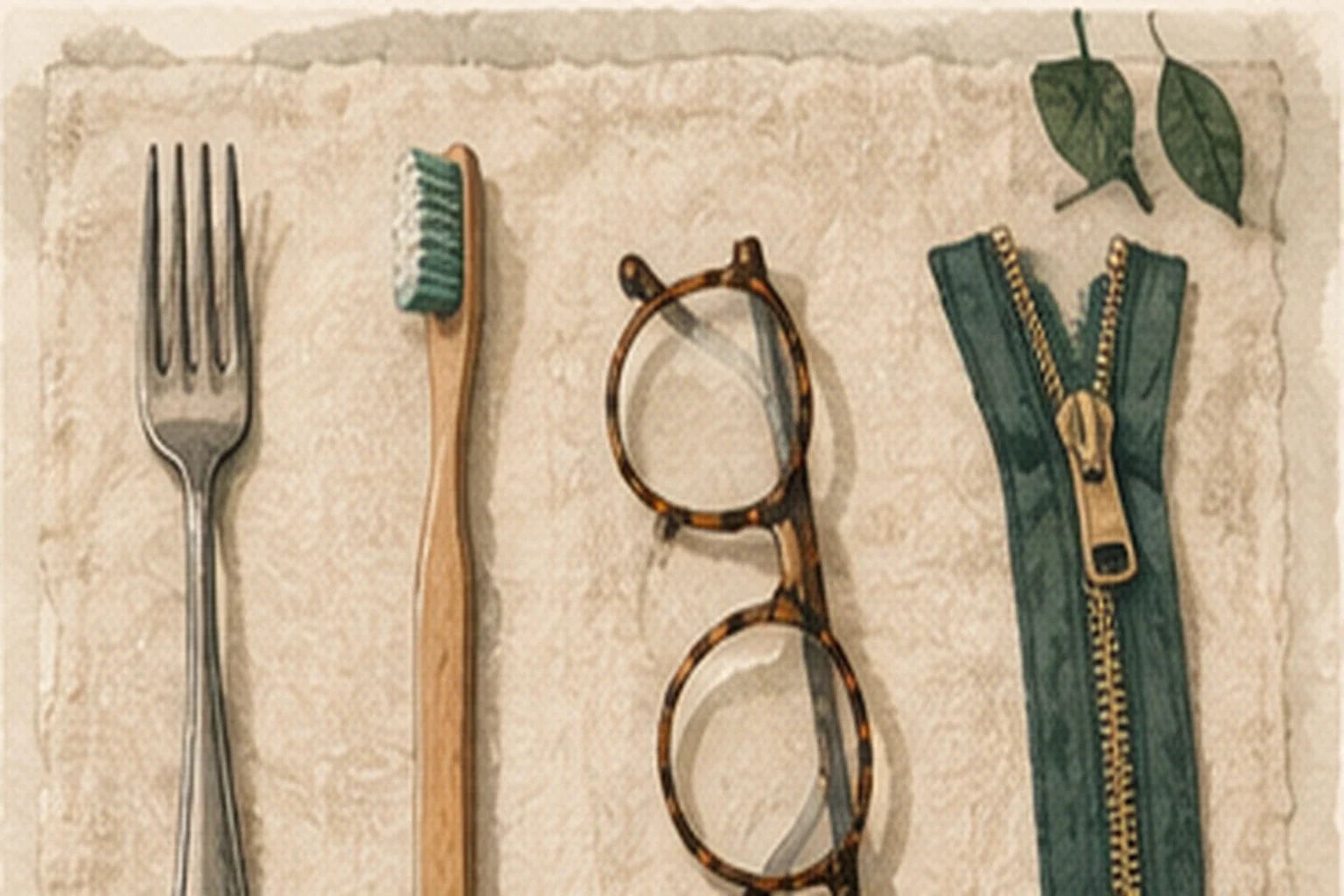
Key takeaways
- Most everyday objects were not invented in a single moment; they reached their modern form through many small steps and several people.
- Some were resisted for a long time: the fork was mocked in England for more than a century.
- Inventors are often unknown or disputed: nobody knows who made the first eyeglasses, and the famous claimant is a hoax.
- Names and success often came from people other than the inventor, as with the zipper, named by a rubber company.
- Each article here traces the object from its earliest evidence to its modern form.
Everyday objects are the hardest things to see. We use a fork, a toothbrush, a pair of glasses or a zipper so often that it never occurs to us to ask where they came from. Yet each has a history full of surprises: forks condemned as sinful, eyeglasses with an unknown inventor, a toothbrush reportedly made in prison, a zipper that kept jamming for twenty years.
This section looks at the objects in our pockets, drawers and kitchens, and asks the same question about each: where did this come from, and who made it the way it is?
Objects without a single inventor
When we ask “who invented it?”, we usually expect a name. Everyday objects rarely give us one. The fork existed for cooking long before anyone ate with it. The bristle toothbrush appeared in China centuries before a mass-produced one appeared in England. The zipper needed one inventor for the idea, another for the design that worked, and a rubber company for the name.
What we call an invention is often the last step in a long process, the moment when an object finally became cheap, reliable or acceptable enough to become ordinary.
The articles in this section
Who Invented the Fork? Forks for eating came to Europe from Byzantium. A Byzantine bride scandalized Venice with a golden fork in 1004, and England resisted the habit until the 19th century.
Who Invented the Toothbrush? From chew sticks to Chinese bristle brushes to William Addis, who made the first mass-produced toothbrush in England around 1780, reportedly while in prison.
Who Invented Eyeglasses? Eyeglasses appeared in Italy in the late 13th century. Their inventor is unknown, and the man honored as their inventor in a Florentine church is the subject of a hoax.
Who Invented the Zipper? Whitcomb Judson patented a clumsy version in 1893; Gideon Sundback made it work in 1913; B.F. Goodrich named it in 1923.
How long it took
| Object | First evidence | When it became ordinary |
|---|---|---|
| Fork | Byzantine tables by the 10th century | Universal in England in the 19th century |
| Toothbrush | Chew sticks from around 3000 BC | Nylon brushes from 1938 |
| Eyeglasses | Italy, 1280s | Gradually, over the following centuries |
| Zipper | Judson’s patent, 1893 | On men’s trousers by the late 1930s |
Three things these stories share
Resistance. New objects were often mocked or distrusted. The fork was condemned as vanity and later laughed at as foreign. The zipper had to fight the button for years.
Many hands. The person remembered as the inventor is usually one of several contributors, and not always the most important.
Anonymous craftsmen. For the oldest objects, the people who actually made them were rarely recorded. The history we have is the history of whoever was written about.
Why it matters
Looking closely at ordinary things changes how we see them. A fork stops being a neutral tool and becomes the result of a thousand years of argument about manners. A pair of glasses becomes a medieval Italian invention that extended the working life of every reader. The objects stay the same; we see more in them.
Objects are one part of what this site explores. The same questions are asked of dishes in Famous Foods, of rituals in Customs & Traditions, and of discoveries in Inventions & Discoveries.
Frequently asked questions
Who invented most everyday objects?
Usually no single person. Most everyday objects developed through many small improvements by different people, and the earliest makers were rarely recorded.
What is the oldest everyday object?
Among the objects covered here, the chew stick, the ancestor of the toothbrush, was in use around 3000 BC.
Why do we credit one inventor for objects with many contributors?
Because a single name makes a simpler story, and because patents, companies and later writers tend to highlight one person.
Who invented eyeglasses?
Nobody knows. They appeared in Italy in the late 13th century, and the most famous claimed inventor is the subject of a later hoax.